Enterprise Service Management
Beyond IT: How HR, Facilities, and Finance Can Benefit from Ticketing Systems
When most employees think of a “service desk,” they picture IT support: password resets, software access, or troubleshooting hardware.
However, every internal service department operates on the exact same core mechanism: a request comes in, needs to be assigned, tracked, fulfilled against a standard, and communicated back to the employee.
When departments like HR, Facilities, and Finance rely on unstructured channels, such as bloated shared email inboxes, hallway conversations, or direct messaging pings, service delivery slows down, accountability drops, and critical tasks slip through the cracks.
Expanding your service desk infrastructure across non-IT operations through Enterprise Service Management (ESM) transforms how your entire organisation handles internal requests. Here is how non-IT teams benefit, and how Hoth’s modular product suite unifies employee support.
The Hidden Cost of the "Shared Email Inbox"
Most non-IT departments default to managing incoming requests via generic email distribution lists like hr@company.com or facilities@company.com. While simple to set up, this model quickly creates operational chaos:
- Zero Ownership: Two team members unknowingly work on the same issue simultaneously, or everyone assumes someone else is handling a high-priority request.
- No Visibility for Employees: Staff members have no line-of-sight into the status of their request, leading to follow-up emails that further clog inboxes.
- Lack of Context: Emails rarely contain all the details needed to resolve an issue, causing back-and-forth communication delays.
- Non-Existent Metrics: Department leaders cannot measure request volumes, peak demand periods, or average resolution times to justify headcount or process improvements.
1. Facilities & Estate Management: From Reactive Repairs to Proactive Maintenance
Facilities management involves physical infrastructure where delayed action can impact employee safety, compliance, or operational continuity.
Key Use Cases
- Maintenance & Repair Logging: Tracking broken equipment, HVAC issues, lighting repairs, or plumbing faults with clear priority levels.
- Desk & Space Allocations: Managing desk bookings, office reconfigurations, or physical move requests.
- Contractor & Visitor Management: Coordinating site visits, safety sign-offs, and building access control.
How Hoth Powers Facilities
With Hoth CAFM (Computer-Aided Facilities Management), estate teams move away from informal email threads to automated work orders, centralised asset tracking, and scheduled preventative maintenance cycles before equipment breaks down.
The challenge is that many facilities teams still struggle to move from reactive to preventative maintenance: a 2026 survey reported that while 90% of facilities managers believe in preventative maintenance, only 26% said they were practising it.
2. Human Resources: Confidentiality, Consistency, and Onboarding
HR teams handle highly sensitive data alongside routine employee inquiries. Managing these via open shared inboxes presents significant data privacy risks.
Key Use Cases
- Employee Onboarding & Offboarding: Triggering multi-department workflows automatically when a new hire joins or a staff member leaves.
- Policy & Benefit Inquiries: Handling questions regarding annual leave, parental policies, pension updates, or health insurance.
- Confidential Employee Relations: Directing sensitive requests directly to specific HR personnel with role-based access security.
How Hoth Powers HR & Governance
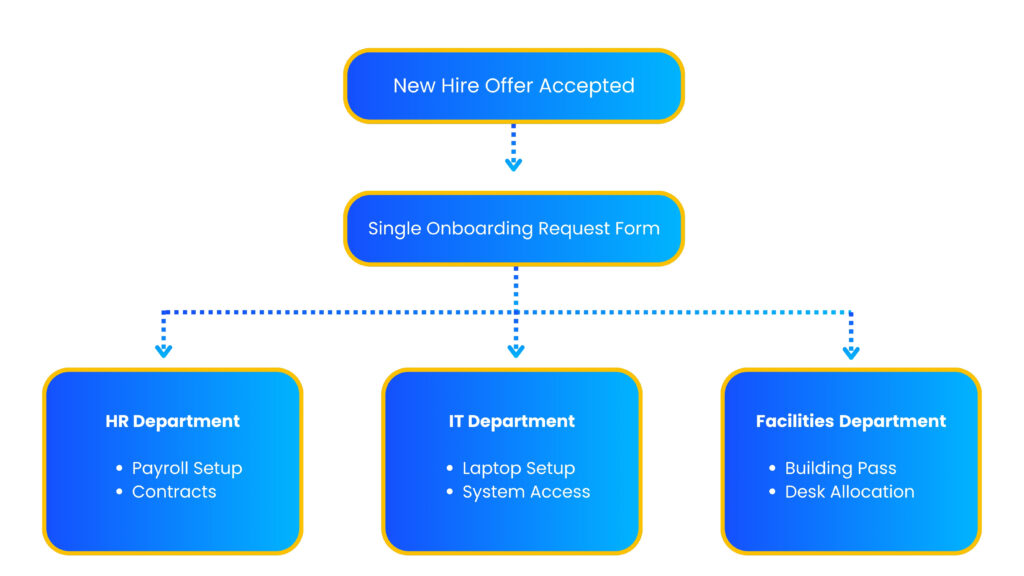
Onboarding is often where cross-departmental coordination breaks down. Research from McKinsey highlights the importance of bringing HR, IT and business operations together around key moments in the employee lifecycle, including onboarding.
With Hoth ESM, HR can submit one single onboarding request that automatically generates dependent sub-tasks for IT (laptop setup), Facilities (building pass and desk assignment), and Finance (payroll inclusion).
For policy distribution and audit readiness, Hoth Hub brings company handbooks, compliance training, and HR documents into one secure, version-controlled platform
3. Finance & Procurement: Audit Trails and Approval Workflows
Finance processes require strict compliance, clear authorization trails, and strict deadline adherence.
Key Use Cases
- Purchase Order (PO) Approvals: Routing invoice queries and purchase requests through pre-defined approval hierarchies.
- Expense Inquiries: Resolving payment discrepancies or expense policy questions.
- Supplier Onboarding: Tracking the collection and verification of new vendor documentation.
How Hoth Powers Finance
Through automated workflow routing in Hoth ESM, every approval, timestamp, and supporting document is permanently linked to the request. This eliminates audit headaches and ensures compliance without requiring manual chasing across departments
The Win-Win: A Single Portal for Employees
From an employee perspective, needing to remember whether to email hr@, message facilities@, or open a ticket for IT creates unnecessary friction.
• Software & system access | • Policy & leave queries | • Maintenance & repair requests |
• Hardware setup & repairs | • Expense & PO approvals | • Desk & room bookings |
• Account & password resets | • Cross-team onboarding | • Building & contractor management |
By consolidating internal services into a single, intuitive platform:
- One Central Destination: Employees submit and track all requests in one portal (or via Microsoft Teams integrations), supported by Hoth AI for context-aware instant answers and smart routing.
- Departmental Autonomy: HR, Facilities, and Finance maintain full control over their confidential data, security levels, and specific workflows.
- Enterprise Visibility: Leadership gains real-time visibility across all internal service delivery through unified reporting dashboards.
Unifying Your Internal Service Operations
Extending your service desk infrastructure beyond IT isn’t about imposing rigid technical frameworks on non-technical teams—it is about giving HR, Facilities, and Finance the specialised tools they need to eliminate manual administration, maintain clear communication, and deliver seamless internal support.
Whether starting with Hoth ITSM, adding Hoth CAFM for facilities, or rolling out Hoth ESM across the wider business, Hoth provides a single, flexible platform that grows alongside your organisation.
Struggling with cross-departmental handoffs?
Onboarding a new team member requires hardware setup in Hoth ITSM, building access and desk allocation in Hoth CAFM, and payroll setup via Hoth ESM. Coordinating this across separate email threads is a recipe for delay.
Our latest guide breaks down how extending your service desk infrastructure gives HR, Facilities, and Finance the structured workflows, asset visibility, and automated handoffs needed to deliver seamless internal service.
Is Your Organisation Ready for ESM?
Ready to move beyond fragmented service delivery? Our ESM Readiness Assessment helps you understand where your organisation stands today and identify opportunities to improve workflows across IT, HR, Facilities and Finance.
Fill out the short checklist, see how ready your organisation is for a more connected, streamlined approach to internal service management — and discover where to focus your next steps.

Making service simple—smarter, faster, together.
Hoth empowers teams to deliver smarter services across IT, Customer Support, Facilities, Governance, and Enterprise Management. Our flexible, AI-supported platform streamlines operations, boosts collaboration, and ensures compliance—making it easy to support your people, processes, and priorities.


Follow Us
Email: info@houseonthehill.com
Sales: +44 161 520 0222
Support: +44 161 528 1259
Company Registration : 2790771. Registered Office Address: 127 Stockport Road, Greater Manchester, UK, SK6 6AF
(C) Copyright 2025. All Rights Reserved. House on the Hill. Designed and Developed by Kode88